Why Under $5,000 Is the Sweet Spot for Home Saunas
If you have been researching home saunas, you have probably noticed that prices span an enormous range, from $1,000 portable pop-up units to $15,000+ custom installations. It is easy to assume that you need to spend at the top of that range to get a quality experience. You do not. For the full breakdown of what every type and tier actually costs, see our 2026 sauna price guide.
The under-$5,000 price bracket is where the best value lives in the infrared sauna market right now. At this level, you get solid construction (real Canadian hemlock or red cedar), effective heating systems (carbon or ceramic-carbon hybrid panels), proper safety certifications, useful features like Bluetooth audio and chromotherapy lighting, and warranties that actually cover meaningful periods. You are not making significant sacrifices compared to saunas that cost two or three times as much.
The features that push saunas above $5,000 are typically full-spectrum infrared (near, mid, and far), premium-grade components from boutique manufacturers, larger capacity (4+ person), and brand prestige. These are nice-to-haves, but for the vast majority of home users, a well-made far-infrared sauna in the $2,500 to $5,000 range delivers 90% of the health benefits at a fraction of the cost.
In this guide, we will break down exactly what you get at different price points within the under-$5,000 range, highlight our top picks from brands we carry and trust, and give you the knowledge to make a confident purchase. If you want to browse our full selection while you read, visit our sauna collection page.
What You Get at Different Price Points
$1,500 - $2,500: Solid Entry-Level
At the $1,500 to $2,500 range, you are entering the world of legitimate, purpose-built infrared home saunas. These are not the flimsy pop-up "sauna blankets" or tent-style units that dominate the sub-$1,000 market. You are getting a freestanding cabin with real wood construction, panel heating elements, and space for 1 to 2 people.
Saunas in this price range typically feature Canadian hemlock construction, which is naturally moisture-resistant and hypoallergenic. Heating is usually far-infrared carbon panels, effective and energy-efficient, though coverage may not be as complete as higher-priced models. You will find basic digital controls, interior lighting, and sometimes Bluetooth speakers or an auxiliary audio input.
The trade-offs at this tier are size and heating coverage. Most models seat 1 to 2 people comfortably, and the carbon panels may not provide full 360-degree coverage, meaning some areas of your body receive more direct infrared heat than others. Preheat times tend to be slightly longer (30 to 40 minutes versus 15 to 25 for premium models), and maximum temperatures may cap around 140°F to 150°F rather than the 150°F to 165°F range of higher-end units.
For a single user who plans to sauna 3 to 5 times per week, this tier delivers genuine health benefits, improved circulation, deep sweating, muscle relaxation, stress reduction, at a very manageable investment. If budget is your primary constraint, a quality sauna in this range will serve you well for years.
$2,500 - $3,500: The Performance Sweet Spot
The $2,500 to $3,500 range is where things get interesting. This is the sweet spot where you start getting features and build quality that rival saunas costing twice as much. Models here typically seat 2 to 3 people, offer more complete heater coverage (panels on the back wall, side walls, under the bench, and sometimes the floor), and include nicer touches like chromotherapy LED lighting, premium audio systems, and tempered glass doors.
Construction quality steps up meaningfully at this price point. You will see thicker tongue-and-groove wood panels, better-insulated walls, more refined joinery, and sturdier hardware. The result is a sauna that holds heat better, looks more polished in your home, and will last longer under daily use. Heater technology may also improve, some models in this range use ceramic-carbon hybrid elements that deliver slightly more intense infrared heat than pure carbon panels.
This is the tier where we see some of our most popular sellers, and for good reason. The jump in quality from the $1,500 to $2,500 range is significant and tangible. For most buyers, spending in this range delivers the best combination of performance, features, and longevity per dollar.
$3,500 - $5,000: Premium Home Sauna
At the top of the under-$5,000 range, you are getting premium home saunas from established, reputable brands, units that compete directly with saunas in the $5,000 to $8,000 bracket on build quality and performance. The difference is usually branding and marketing margin, not materials or engineering.
Saunas in this tier commonly feature low-EMF carbon heating panels with full surround coverage (back, sides, legs, calves, and floor), thick double-walled Canadian hemlock or red cedar construction, heavy-duty tempered glass doors, advanced digital controls with programmable presets, premium Bluetooth audio, chromotherapy lighting systems, and comprehensive warranties (5 to 7 years on the cabin, lifetime on the heaters).
Capacity typically ranges from 2-person to 4-person models. Preheat times are shorter (15 to 20 minutes), maximum temperatures reach 150°F to 165°F, and the overall experience feels like a professional spa installation rather than a consumer product. If you are investing in a sauna as a long-term fixture in your home, something you will use daily for years, the $3,500 to $5,000 range delivers a genuinely premium experience without crossing into diminishing-returns territory.
Our Top Picks Under $5,000
At Strength & Wellness Supply, we are authorized dealers for Dynamic Saunas, one of the most trusted names in home infrared saunas. Here are our top recommendations in the under-$5,000 category, every price below reflects what is actually live on our site today, and every model links to its current product page so you can verify specs and availability yourself. Browse the full lineup in our sauna collection.
Dynamic Cardoba Elite 2-Person Ultra Low EMF FAR Infrared Sauna, $2,299
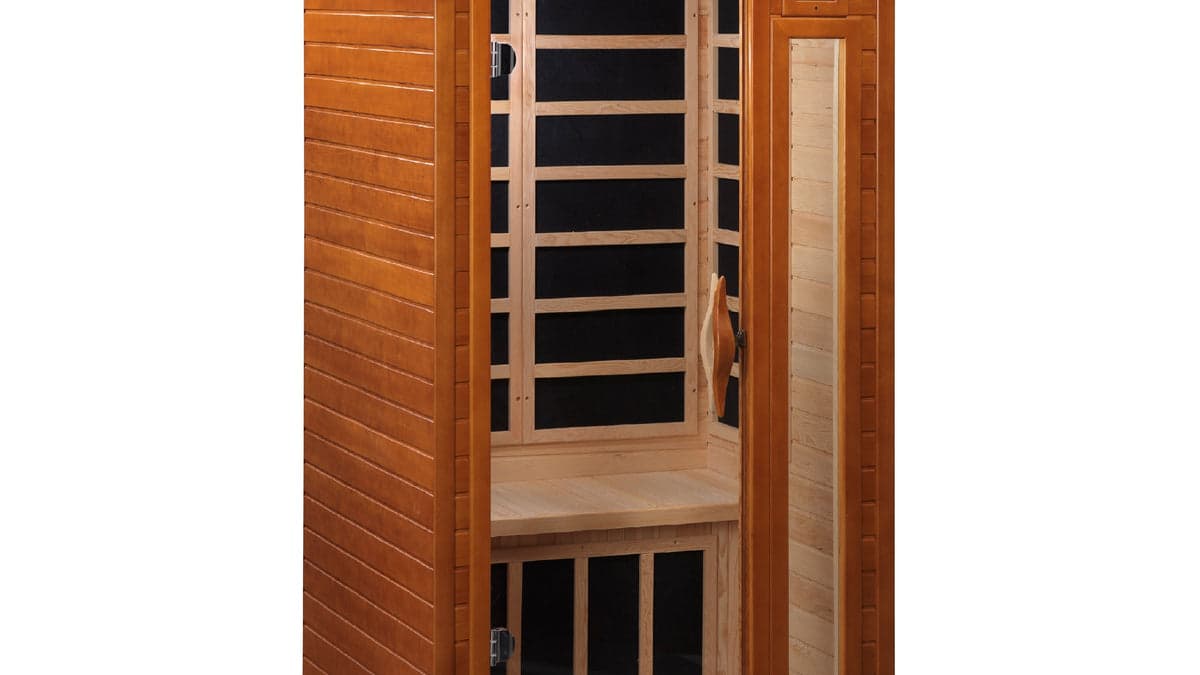
The Cardoba Elite is our best-overall pick under $5,000 and one of the most heavily-featured saunas on our paid landing pages. The "Ultra Low EMF" designation means the carbon heating panels have been engineered to minimize electromagnetic field emissions, a feature increasingly important to health-conscious buyers. You get Canadian hemlock construction, full surround heater coverage, dual interior and exterior digital controls, chromotherapy LED lighting, and a Bluetooth audio system, all in a 2-person cabin that fits comfortably in a spare bedroom or basement corner.
What makes the Cardoba Elite the top pick is the combination of premium build quality and an aggressive price. At $2,299, you are getting a sauna with build quality that easily competes with units priced $1,000 to $2,000 higher. If you want the best premium-grade 2-person experience without crossing the $3,000 mark, this is the one to start with.
Dynamic Venice Elite 2-Person Ultra Low EMF FAR Infrared Sauna, $2,699
The Venice Elite is the closest sibling to the Cardoba Elite, same Ultra Low EMF carbon heating technology, same Canadian hemlock construction, same digital controls and chromotherapy. The differences are primarily in cabin geometry and bench layout: the Venice Elite has a slightly different footprint that some buyers prefer for tighter spaces or specific room shapes. At $2,699, it sits $200 above the Cardoba Elite, which mostly reflects the design refinement rather than a meaningful performance gap.
If you are torn between the Cardoba Elite and Venice Elite, the practical answer is to measure your installation space and choose the cabin geometry that fits best. From a heating, EMF, and feature standpoint, the two are essentially equivalent.
Dynamic Lucca Elite 2-Person Ultra Low EMF FAR Infrared Sauna, $3,299
The Lucca Elite steps you up from the Cardoba/Venice tier with refined construction, additional interior detailing, and a slightly more upscale feel inside the cabin. Same Ultra Low EMF carbon heating platform, same Canadian hemlock, but with the kind of fit-and-finish that becomes obvious the first time you sit inside it. At $3,299, the Lucca Elite is the right pick if you want a premium 2-person experience and are willing to spend an extra $1,000 over the Cardoba Elite for noticeably nicer materials and joinery.
For most buyers, the upgrade from Cardoba Elite to Lucca Elite is genuinely worth the difference if budget allows, but if you are weighing $2,299 versus $3,299 on a tight budget, the Cardoba Elite delivers the same core health benefits at a meaningfully lower price.
Dynamic Bergamo Elite 4-Person Ultra Low EMF FAR Infrared Sauna, $3,999
The Bergamo Elite is our top pick if you need 4-person capacity. Most 4-person saunas in this quality range start at $5,000 or more, the Bergamo Elite delivers genuine 4-person space, the same Ultra Low EMF carbon heating platform as the Cardoba and Venice Elite, and a footprint of approximately 75 x 49 inches that still fits in most spare bedrooms or basement bays. It is the hero anchor on our Low EMF Full Spectrum Saunas landing page for that reason.
If you sauna with a partner, do contrast therapy with a friend, or just want extra room to lie back and stretch out, the Bergamo Elite is the most defensible 4-person choice under $5,000 in our entire catalog. For more 3-person and 4-person options at this tier, browse our sauna collection or request a free pricing & delivery quote.
Key Features to Compare When Shopping
With so many home saunas on the market, it helps to have a structured framework for comparison. Here are the features that matter most, ranked roughly by importance for the typical home user.
Heater Type and Coverage
The heating system is the heart of any infrared sauna. Carbon panel heaters are the current standard, they produce gentle, even far-infrared heat across a large surface area, run at lower surface temperatures (meaning they are safer to lean against), and are highly energy-efficient. Ceramic heaters produce more intense, focused heat but cover less area and run hotter to the touch. Carbon-ceramic hybrid panels aim to combine the best of both.
More important than heater type is heater coverage. Look for saunas with panels on the back wall, both side walls, under the bench (for calves and hamstrings), and ideally near the floor. Full surround coverage means more of your body receives direct infrared heat, which translates to a more effective and comfortable session. A sauna with 8 to 10 well-placed carbon panels will outperform a sauna with 4 to 6 panels every time, regardless of the heater brand or marketing claims.
EMF Levels
Electromagnetic field (EMF) emissions from infrared heaters have become a significant concern for health-conscious buyers. While the research on low-level EMF exposure is still evolving, the precautionary principle makes sense, especially in a device you will sit inside for 20 to 40 minutes at a time, multiple days per week. Look for saunas marketed as "low EMF" or "ultra low EMF" with published testing data showing emissions below 3 milligauss (mG) at the seating position. Premium models from brands like Dynamic Saunas routinely achieve emissions well below this threshold.
Wood Quality and Construction
The wood used in sauna construction affects durability, appearance, aroma, and even air quality. Canadian hemlock is the most common choice in the under-$5,000 range, it is lightweight, moisture-resistant, hypoallergenic, and has a clean, neutral appearance. Western red cedar is a premium alternative that adds a pleasant natural aroma and has slightly better moisture resistance, but it costs more and has a stronger visual character that does not suit every interior.
Pay attention to construction details: tongue-and-groove panel assembly (better than flat panels with exterior framing), consistent grain and color (indicating quality lumber selection), smooth sanding with no rough spots or splinters, and tight-fitting joints throughout. A well-constructed sauna feels solid when you press on the walls and does not wobble or shift when you lean against the bench.
Controls and Features
Digital temperature controls with both interior and exterior panels are standard on quality saunas. Interior controls let you adjust mid-session without opening the door, while exterior controls let you preheat the sauna before stepping in. Programmable timers and temperature presets are useful for dialing in your preferred settings.
Bluetooth audio and chromotherapy (color-changing LED) lighting are now common even on mid-range models. While these features do not affect the health benefits, they meaningfully enhance the experience. A relaxing session with calming music and warm amber lighting feels significantly different from sitting in silence under a fluorescent bulb. The best saunas integrate these features seamlessly so they feel like a natural part of the design rather than afterthoughts bolted on.
Installation Tips: Setting Up Your Home Sauna
One of the biggest advantages of modern infrared home saunas is how straightforward installation is. Unlike traditional steam saunas that require dedicated electrical circuits, vapor barriers, drainage, and specialized ventilation, most infrared saunas are designed as plug-and-play units that a handy homeowner can assemble in 1 to 2 hours.
Choosing the Right Location
Your sauna needs a flat, level surface, access to a standard 120V or 240V outlet (check the specifications for your specific model, most 1 to 3 person units run on 120V, while some larger models require 240V), and adequate clearance. Plan for at least 6 inches of clearance on all sides and 12 inches above the unit for airflow and maintenance access.
Popular locations include spare bedrooms, basements, garages, master bathrooms, and covered outdoor areas. Basements and garages are ideal because they typically have hard flooring, good ventilation, and space to spare. If placing in a finished room, protect the flooring beneath the sauna with a waterproof mat, while infrared saunas produce far less moisture than steam saunas, sweat drips are inevitable.
Avoid placing your sauna directly against exterior walls in cold climates, as the temperature differential can reduce heating efficiency. Interior walls or insulated garage spaces are preferable. If an outdoor covered area is your only option, ensure the sauna is fully protected from rain and direct sun, and be aware that heating performance may decrease in very cold weather.
Assembly Process
Most home infrared saunas ship as pre-assembled wall panels, a bench, a floor, and a roof section. The panels connect with interlocking clips, buckles, or screws, and the heating panels are pre-wired into the wall sections. Typical assembly takes 60 to 90 minutes for two people and requires only basic tools, a Phillips screwdriver and possibly a rubber mallet for snug-fitting panels.
Read the entire instruction manual before starting. Lay out all panels and hardware, verify all pieces are present and undamaged, and follow the assembly sequence exactly. Most manufacturers design a specific assembly order (usually floor first, then back wall, side walls, front/door, bench, and roof) that ensures proper alignment. Going out of sequence can create alignment issues that are frustrating to correct.
Electrical Considerations
Standard 120V models simply plug into a dedicated wall outlet, no electrician required. "Dedicated" means the outlet is on its own circuit breaker and not shared with other high-draw appliances. Most home saunas draw 1,500 to 1,800 watts on a 15 or 20 amp circuit. Check that your outlet is grounded and in good condition. Do not use extension cords, they are a fire hazard with high-draw appliances.
Larger 240V models (typically 4+ person saunas) require a dedicated 240V circuit installed by a licensed electrician. This is a straightforward job for an electrician, similar to installing a dryer outlet, but budget $200 to $500 for the electrical work if you do not already have a suitable outlet nearby. Factor this into your total cost when comparing 120V and 240V models.
First-Use Tips
Before your first sauna session, run the unit at maximum temperature for 30 to 45 minutes with the door slightly open. This "burn-in" period allows any residual manufacturing odors (from packaging materials, sealants, or new wood) to dissipate. Some slight wood aroma is normal and pleasant, it should smell like fresh lumber, not chemicals. If you notice strong chemical odors that persist after the burn-in, contact the manufacturer.
Place towels on the bench and floor to absorb sweat during sessions. This keeps the wood clean and extends the life of your sauna. Most manufacturers recommend wiping down the interior with a damp cloth after each use and leaving the door open for 15 to 20 minutes to allow moisture to evaporate. With this minimal maintenance, a quality infrared sauna will last 15 to 20 years or more.
Frequently Asked Questions
Here are the questions we hear most often from customers shopping for home saunas under $5,000.
How much does a home sauna cost?
A quality freestanding home infrared sauna typically costs between $1,500 and $5,000, depending on size, build quality, and features. Legitimate entry-level 1-to-2-person cabins start around $1,500 to $2,500; the performance sweet spot for 2-to-3-person models with full heater coverage and premium features runs $2,500 to $3,500; and premium under-$5,000 saunas land in the $3,500 to $5,000 range. From our own catalog, the 2-person Dynamic Cardoba Elite is $2,299, the Venice Elite is $2,699, the Lucca Elite is $3,299, and the 4-person Bergamo Elite is $3,999, every price live on its product page today. Above $5,000 you are paying for full-spectrum infrared, 4-plus-person capacity, boutique-brand prestige, or custom installation, which most home users do not need. Portable sauna blankets and pop-up tents sell for under $1,000 but are not comparable to a real cabin sauna in heat coverage, durability, or experience.
How much does it cost to run an infrared sauna?
Most home infrared saunas draw between 1,500 and 1,800 watts, comparable to a space heater. At the national average electricity rate of roughly $0.16 per kWh, a 30-minute session costs approximately $0.12 to $0.15. Even with daily use, your monthly electricity increase will be $4 to $5. Infrared saunas are one of the most energy-efficient wellness investments you can make, orders of magnitude cheaper to operate than a hot tub, pool, or traditional steam sauna.
Do I need a dedicated electrical circuit?
For 120V models (most 1 to 3 person saunas), you need a standard grounded outlet on a dedicated 15 or 20 amp circuit, meaning no other appliances share that circuit breaker. Most rooms in modern homes have outlets that qualify. For 240V models, you will need a licensed electrician to install a dedicated outlet, similar to a dryer connection. Budget $200 to $500 for this work.
How long does it take to heat up?
Most quality infrared saunas in the under-$5,000 range preheat to operating temperature (120°F to 140°F) in 15 to 25 minutes. Some budget models take 30 to 40 minutes. Unlike traditional saunas, you can enter an infrared sauna before it reaches full temperature, the infrared panels begin emitting beneficial far-infrared waves as soon as they warm up, so you start receiving benefits during the preheat phase.
Is infrared safe?
Yes. Far-infrared is the same type of heat your body naturally emits. It is a completely different part of the electromagnetic spectrum from ultraviolet (UV) radiation, there is no UV exposure in an infrared sauna. Low-EMF models further minimize electromagnetic field exposure. Infrared saunas are used in clinical settings worldwide, and decades of research support their safety for healthy adults. As with any heat therapy, consult your physician if you have cardiovascular conditions, are pregnant, or take medications that affect heat tolerance.
How much space do I need?
A typical 2-person infrared sauna has a footprint of approximately 48 x 42 inches, about the size of a large closet. A 3-person model runs approximately 60 x 48 inches, and a 4-person model approximately 75 x 49 inches. Add 6 inches of clearance on all sides and 12 inches above. Most spare bedrooms, basement corners, or garage sections easily accommodate a 2 to 3 person unit.
What maintenance is required?
Infrared saunas require minimal maintenance. After each session, wipe the bench and floor with a damp cloth to remove sweat residue, and leave the door open for 15 to 20 minutes to air dry. Periodically (every few months), you can lightly sand any rough spots that develop on the wood and apply a food-grade wood treatment if desired. There are no filters to change, no water to treat, and no chemicals to manage, a stark contrast to the maintenance demands of hot tubs and steam saunas.
Can I use a sauna outdoors?
Some home infrared saunas are rated for covered outdoor use. The sauna must be fully protected from rain, snow, and direct sun, a covered patio, screened porch, or enclosed gazebo works. Outdoor use in cold climates will increase preheat time and energy consumption, as the sauna has to work harder to overcome the temperature differential. Check the manufacturer's warranty to confirm outdoor use is covered, as some warranties are voided by outdoor installation.
Ready to Find Your Sauna?
Browse our complete sauna collection to compare all available models side by side. If you have questions about sizing, features, or which model is the best fit for your space and budget, email us at support@strengthwellnesssupply.com or reach out through our website. We are real people who use these products and love helping customers find the right setup.
Tags
Need help choosing?
Tell us your space, budget, and goal, we'll send 2-3 real picks with accurate freight and transparent pricing. One reply from a US-based specialist within a few business hours. No spam.