Why a Home Sauna Is Worth the Investment
A home sauna eliminates the ongoing cost and inconvenience of gym or spa memberships. At $30-50 per sauna session at a commercial facility, or $100-200 per month for a wellness center membership, a home sauna typically pays for itself within 1-3 years, and then delivers free sessions for the next decade-plus.
Beyond the financial equation, having a sauna at home means you'll actually use it. No driving, no scheduling, no sharing with strangers. You can step in for a 20-minute session before bed, first thing in the morning, or after a workout, whenever it fits your routine. Research consistently shows that frequency of use is the biggest predictor of long-term health benefits from sauna bathing.
But with dozens of brands, multiple heating technologies, and prices ranging from $1,500 to $20,000+, choosing the right sauna can feel overwhelming. This guide breaks down every decision factor so you can buy with confidence, and if you would rather answer a few questions instead of reading it all, the Find My Sauna tool narrows it for you.
Step 1: Choose Your Sauna Type
Infrared Saunas, Best for Most Homes
Infrared saunas use carbon or ceramic heaters to warm your body directly with infrared light waves. The cabin air stays at a comfortable 120-150°F while your body is deeply heated from within. They're the most popular choice for home installation because they:
- Plug into standard 120V household outlets (1-2 person models)
- Require no special ventilation, plumbing, or construction
- Assemble in 30-60 minutes with snap-together panels
- Heat up in just 15-20 minutes
- Cost only $0.15-0.50 per session to operate
- Range from $1,500-$8,000 for quality models
Best for: Apartments, condos, bedrooms, garages, basements, covered patios. Anyone who wants an easy plug-and-play installation.
Traditional (Finnish) Saunas, For Purists and Outdoor Builds
Traditional saunas heat the air to 180-200°F using electric or wood-burning heaters with optional steam (water poured on hot rocks). They deliver the classic, intense sauna experience but require more infrastructure:
- Usually require 240V dedicated electrical circuits
- Need proper ventilation (air exchange system)
- May require waterproofing and drainage
- Longer heat-up time (30-60 minutes)
- Higher operating costs ($0.50-2.00 per session)
- Range from $3,000-$20,000+ including installation
Best for: Dedicated sauna rooms, outdoor installations, backyards, pool houses. Those who value the authentic Finnish sauna experience with steam.
Barrel Saunas, Outdoor Character
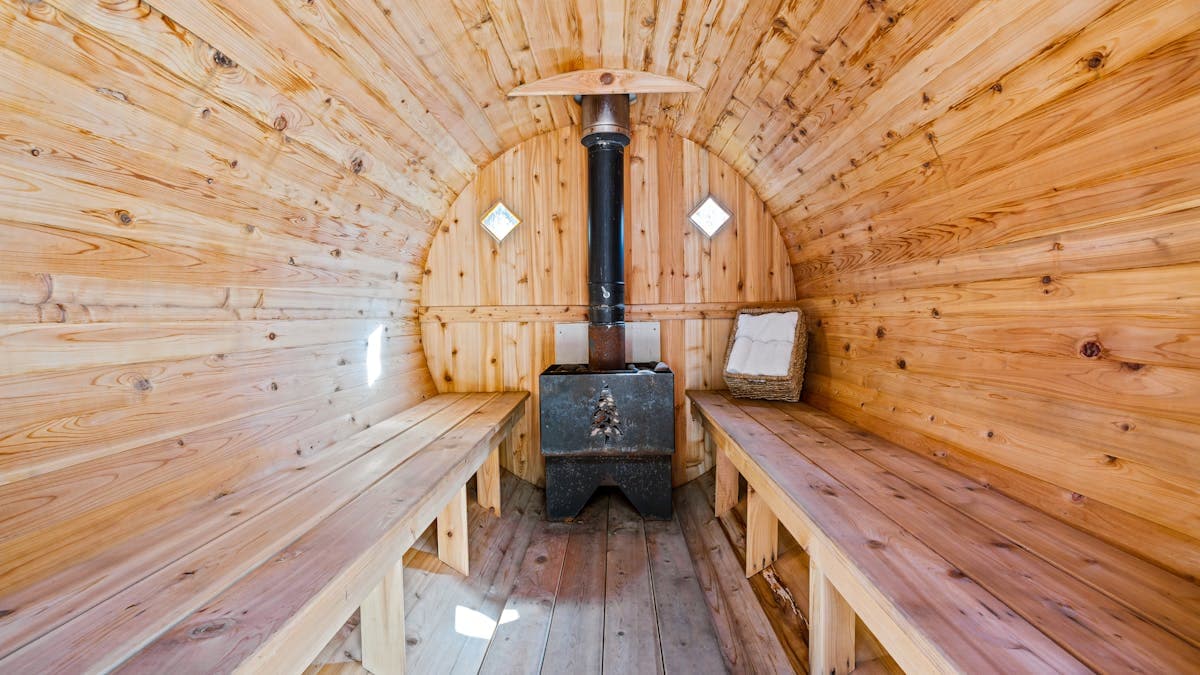
Barrel saunas are cylindrical outdoor saunas (available in both traditional and infrared) that have become incredibly popular for backyards. Their rounded shape is structurally efficient, sheds rain and snow naturally, and creates an attractive focal point. They're available as traditional (electric or wood-burning) or infrared models, with prices from $3,000-$12,000+.
Best for: Backyards, lake houses, cabins, outdoor entertaining spaces. Those who want a statement piece that also delivers an exceptional sauna experience.
Step 2: Determine the Right Size
Sauna size is measured by capacity (1-person, 2-person, 3-person, etc.) but what matters most is the interior dimensions and how comfortably you can sit and move inside.
1-Person Saunas
Interior width: ~36-40 inches. Perfect for solo users with limited space. Fits in a closet, bathroom corner, or small apartment. Great for a dedicated personal wellness ritual. However, they can feel cramped for larger individuals, if you're over 6 feet tall or broad-shouldered, consider a 2-person model even for solo use.
2-Person Saunas (Most Popular)
Interior width: ~47-50 inches. The sweet spot for most buyers. Comfortably fits one person with room to stretch and shift positions, or two people sitting side by side. Wide enough to lie down in some models. Compact enough for a spare bedroom, garage corner, or covered patio. This is the size we recommend for most buyers.
3-Person Saunas
Interior width: ~55-60 inches. Ideal for couples who sauna together regularly, or anyone who wants a spacious personal experience. Often features L-shaped or bench seating. Requires more floor space, plan for about 5' x 4' of room footprint plus clearance.
4+ Person Saunas
Interior dimensions vary widely. Great for families or social sauna sessions. Some models include multiple benches at different heights. These are substantial pieces of equipment, ensure you have the space, electrical capacity (often 240V), and access to get it into your home.
Pro Tip: Measure Your Space First
Before shopping, measure the space where you plan to put the sauna. Add 4-6 inches of clearance on each side and above for airflow. Account for the door swing radius. Then check specific model exterior dimensions against your available space.
Step 3: Choose Your Placement Location
Indoor Locations
Spare Bedroom: The most common indoor location. Infrared saunas produce minimal humidity and can be placed on any flooring. Just ensure the room has a standard electrical outlet on a 15A or 20A circuit.
Basement: Excellent choice, basements stay cool, which means your sauna heats up faster. Good for traditional saunas too, since basements often have floor drains and are easier to vent.
Garage: Works well for infrared saunas year-round. If your garage isn't climate-controlled, expect slightly longer heat-up times in winter. Ensure the sauna is protected from moisture and not in a path where it might get bumped by vehicles.
Bathroom: A natural fit since you're already near a shower for rinsing off after your session. Compact 1-person models work well in larger bathrooms.
Outdoor Locations
Covered Patio/Deck: Many infrared saunas can be placed on a covered patio as long as they're protected from direct rain, snow, and sprinklers. Check the manufacturer's warranty, some cover outdoor use, others don't.
Backyard (Barrel/Outdoor Models): Purpose-built outdoor saunas and barrel saunas are designed for full weather exposure. They typically feature weather-resistant wood (Western Red Cedar), weatherproof roofing, and sealed electrical connections.
Key Placement Considerations
- Level surface: The sauna must sit on a flat, level surface capable of supporting its weight (200-800 lbs depending on size)
- Airflow clearance: Leave 4-6 inches on all sides and 12+ inches above for proper air circulation
- Proximity to electrical: Avoid extension cords, the outlet should be within reach of the sauna's power cord
- Access path: Sauna panels need to get into the room, measure doorways, hallways, and stairways
- Floor protection: Use a waterproof mat under the sauna if placing on carpet or hardwood to catch any sweat drips
Step 4: Evaluate Key Features
Heater Technology (Infrared Saunas)
Carbon Fiber Panels: The modern standard. Carbon heaters produce even, consistent heat with low surface temperatures. They cover more surface area than ceramic and heat up faster. Look for full-body coverage (front, back, sides, and calf heaters).
Full Spectrum vs. Far Infrared: Far infrared heaters (6-12 microns) are the most common and deliver excellent deep tissue warming. Full spectrum models add near-infrared and mid-infrared wavelengths, which may offer additional benefits for skin health and pain relief at a 30-50% price premium.
EMF Levels
Low EMF (electromagnetic field) emissions are critical. Look for saunas with EMF readings below 3 milligauss (mG) at the seating position. Reputable brands publish their EMF test results. If a brand doesn't disclose EMF data, that's a red flag.
Wood Type
- Canadian Hemlock: Light-colored, hypoallergenic, durable, and naturally resistant to warping. The most common wood in quality infrared saunas. Excellent value.
- Canadian Red Cedar: Beautiful grain, naturally aromatic, superior moisture resistance. Often found in premium models and outdoor saunas. Slightly more expensive.
- Basswood: Extremely soft, hypoallergenic, doesn't get as hot to the touch. Good for those with wood sensitivities.
Comfort and Convenience Features
- Chromotherapy lighting: LED color therapy lights, nice to have but not essential
- Bluetooth speakers: Listen to music, podcasts, or guided meditations during sessions
- Digital control panels: Interior and/or exterior temperature controls with preset timers
- Ergonomic backrests: Curved backrests improve comfort during longer sessions
- Glass door/windows: Tempered glass doors reduce claustrophobia and let in light
Step 5: Set Your Budget
Budget Tiers for Infrared Saunas
Entry-Level ($1,500-$2,500): 1-2 person far infrared saunas from reputable brands. You'll get quality carbon heaters, solid wood construction, and basic amenities (Bluetooth, chromotherapy). These are excellent saunas, you're not sacrificing quality, just size and premium features. Brands like Dynamic offer outstanding value in this range.
Mid-Range ($2,500-$5,000): 2-3 person saunas with premium construction, more heater panels for better coverage, full spectrum options, and enhanced amenities. This is where you'll find the best balance of value and features. Maxxus saunas excel in this tier with thicker panels and premium wood.
Premium ($5,000-$10,000+): Large capacity (3-4+ person), full spectrum heating, premium wood throughout, advanced control systems, and exceptional build quality. Worth it if you plan to use the sauna daily as a family or couple and want the best possible experience.
What Those Tiers Look Like in Our Catalog
Price bands are easier to act on with real models attached. Every price below is our current MAP as of August 2026:
- Entry-Level: Dynamic Avila $1,899, Dynamic Barcelona $1,899, Dynamic Santiago 2-Person $2,099, Dynamic Cardoba Elite 2-Person $2,299
- Mid-Range: Dynamic Lugano 3-Person $2,699, Dynamic Santiago 2-Person Full Spectrum $3,299, Dynamic Lugano Elite 3-Person $2,999, Dynamic Bergamo Elite 4-Person $3,999, Maxxus 3-Person Full Spectrum Canadian Red Cedar $4,899
- Premium: Finnmark FD-2 Full Spectrum 2-Person $5,995, Dynamic Monaco 6-Person $6,499, Golden Designs Catalonia 8-Person Full Spectrum $8,999
What an Extra Seat Actually Costs
"Size up if you are torn" is easy advice to give and harder to budget for, so here is the real number from a single product line. Within Dynamic's low EMF far infrared range the ladder runs Santiago 2-person at $2,099, Lugano 3-person at $2,699, and Bergamo 4-person at $3,299. That is exactly $600 per additional seat, twice in a row.
Two things follow from that. Capacity is the most predictable upgrade in the catalog, so choosing between a 2-person and a 3-person cabin is a $600 decision rather than a jump between budget tiers. And capacity is often cheaper than changing the heat technology on the same cabin: moving an identical Dynamic model from far infrared to full spectrum runs $400 to $1,000 depending on the model, which we priced out pair by pair in our full spectrum vs far infrared comparison. If the budget only stretches one way, the extra room is the safer buy for most households.
Don't Forget These Costs
- Delivery: Many quality brands include free curbside or white-glove delivery
- Electrical: Standard 120V = no additional cost. If you need a 240V circuit installed, expect $200-500 from an electrician
- Accessories: Sauna towels, seat cushions, floor mat, water bottle, budget $50-150
- Operating cost: $10-20/month for daily use (electricity)
Financing
We offer financing through Shop Pay Installments (subject to approval), allowing you to break the cost into manageable monthly payments. A $3,000 sauna financed over time is often less per month than a gym membership that includes sauna access.
Common Mistakes to Avoid
- Buying on price alone: A $799 "sauna" on Amazon with no brand reputation, unknown EMF levels, and questionable wood quality is not a deal, it's a risk. Stick with established brands that stand behind their products with strong warranties.
- Ignoring EMF data: Any brand that doesn't publish EMF test results for their heaters should be avoided. Low EMF is a fundamental safety requirement, not a premium feature.
- Getting too small: If you're debating between two sizes, go larger. You'll appreciate the extra room, especially for longer sessions. A 2-person sauna used solo is far more comfortable than a cramped 1-person unit.
- Not measuring your space: Including clearances, door swings, and access paths. Getting a sauna that doesn't fit is an expensive and frustrating mistake.
- Skipping the break-in: Always run your new sauna at max temperature for 30-45 minutes before your first session to off-gas any manufacturing residues. This is especially important with wood construction.
- Forgetting about delivery access: Can the sauna panels get through your doorways? Up your stairs? Through hallways? Most saunas ship in panels, but those panels can be large and heavy. Measure everything.
Frequently Asked Questions
What's the difference between a sauna and an infrared sauna?
A traditional sauna heats the air around you to 180-200°F using an electric or wood-burning heater, often with steam from water poured on hot rocks. An infrared sauna instead uses carbon or ceramic heaters to warm your body directly with infrared light, so the cabin stays a milder 120-150°F while you still sweat deeply. Infrared models are far easier to install at home, while traditional saunas deliver the classic high-heat, steam experience.
How much does a home sauna cost?
Quality infrared saunas for the home generally range from $1,500 to $8,000 depending on size, materials, and spectrum, while traditional and outdoor builds run $3,000 to $20,000+ including installation. A 2-person far infrared model from a reputable brand, the most popular choice for first-time buyers, typically falls in the $2,000-$3,500 range.
Are home saunas safe?
Yes, when you choose a reputable brand. The two safety factors that matter most are low EMF (electromagnetic field) heaters with published test results, and quality, non-toxic wood construction. Always run a new sauna empty at maximum temperature for 30-45 minutes to off-gas any manufacturing residues before your first session, and stay hydrated during use.
What temperature does a home sauna run at?
Infrared saunas operate at a comfortable 120-150°F because they heat your body directly rather than warming all the air. Traditional Finnish saunas run hotter, typically 180-200°F. Both produce a deep sweat, infrared simply achieves it at a lower ambient air temperature, which many people find easier to tolerate.
Does a home sauna need special electrical wiring?
Most 1- and 2-person infrared saunas plug into a standard 120V household outlet with no special wiring, ventilation, or plumbing required. Larger infrared models and most traditional saunas need a dedicated 240V circuit, which an electrician can install for roughly $200-500 if you do not already have one.
What size home sauna should I get?
The 2-person size (about 47-50 inches of interior width) is the sweet spot for most buyers, it fits a spare bedroom, garage corner, or covered patio yet stays roomy enough to stretch out. If you are deciding between two sizes, go larger: a 2-person sauna used solo is far more comfortable than a cramped 1-person unit. Our free Find My Sauna tool can match you to the right size in four quick questions.
Our Recommendation
For most first-time home sauna buyers, we recommend a 2-person far infrared sauna from a reputable brand like Dynamic or Maxxus in the $2,000-$3,500 price range. This gives you excellent heating technology, quality construction, modern features, and enough room for comfortable sessions, all without requiring special electrical work or construction.
In our catalog that recommendation lands on three specific cabins: the Dynamic Santiago 2-Person at $2,099 for the lowest entry point on a true 2-person bench, the Dynamic Cardoba Elite 2-Person at $2,299 for the ultra low EMF heater package, and the Dynamic Lugano 3-Person at $2,699 if you would rather put the difference into floor space than into heater tier.
If you have the budget and want the broadest range of benefits, step up to a full spectrum model. If outdoor placement and aesthetics matter, explore barrel saunas for a unique backyard experience.
Whatever you choose, the most important thing is to use it consistently. Three to four sessions per week is where most people begin to notice meaningful improvements in sleep, recovery, stress levels, and overall well-being.
If outdoor placement and aesthetics matter, explore our top outdoor barrel sauna picks for 2026, cedar, traditional, and premium barrel kits reviewed with real MAP pricing.
Not sure where to start? Try our free Find My Sauna tool, answer four quick questions about your space, capacity, heat preference, and budget, and we will match you to the best-fit models. No email required to see your results.
First time buying a sauna sight unseen? Our guide on whether it is safe to buy a sauna online walks through exactly what happens after you order, from freight delivery to the damage-claim window. Ready to compare models and prices? Visit our home sauna pricing guide for a full breakdown across all tiers and sizes.
Tags
Need help choosing?
Tell us your space, budget, and goal, we'll send 2-3 real picks with accurate freight and transparent pricing. One reply from a US-based specialist within a few business hours. No spam.