The Quick Answer
Most people frame this as a taste question. It is really a budget and electrical question, and the catalog answers it faster than any opinion can.
Buy indoor if you want the lowest price of entry, you have a spare room, garage corner or basement wall, and you would rather plug the sauna in than schedule an electrician. Indoor infrared cabins start at $1,399.
Buy outdoor if you specifically want the traditional hot-rock steam experience, you have a level pad or patio for it, and you are comfortable with a dedicated 240V circuit. Outdoor saunas start at $4,999.
That $3,600 gap between the two entry points is the real decision. Everything below explains what it buys and where it does not matter.
The One Catalog Fact That Settles Most of These
A lot of shoppers arrive wanting an infrared sauna in the backyard. It is worth knowing early that this combination is rare, and we do not stock it.
Of the 38 outdoor saunas we carry, every single one is a traditional steam or hybrid model. There are 27 traditional and 11 hybrid, and zero pure infrared. Of the 105 indoor saunas we carry, 88 are infrared.
So in practice the placement decision and the heat decision are the same decision:
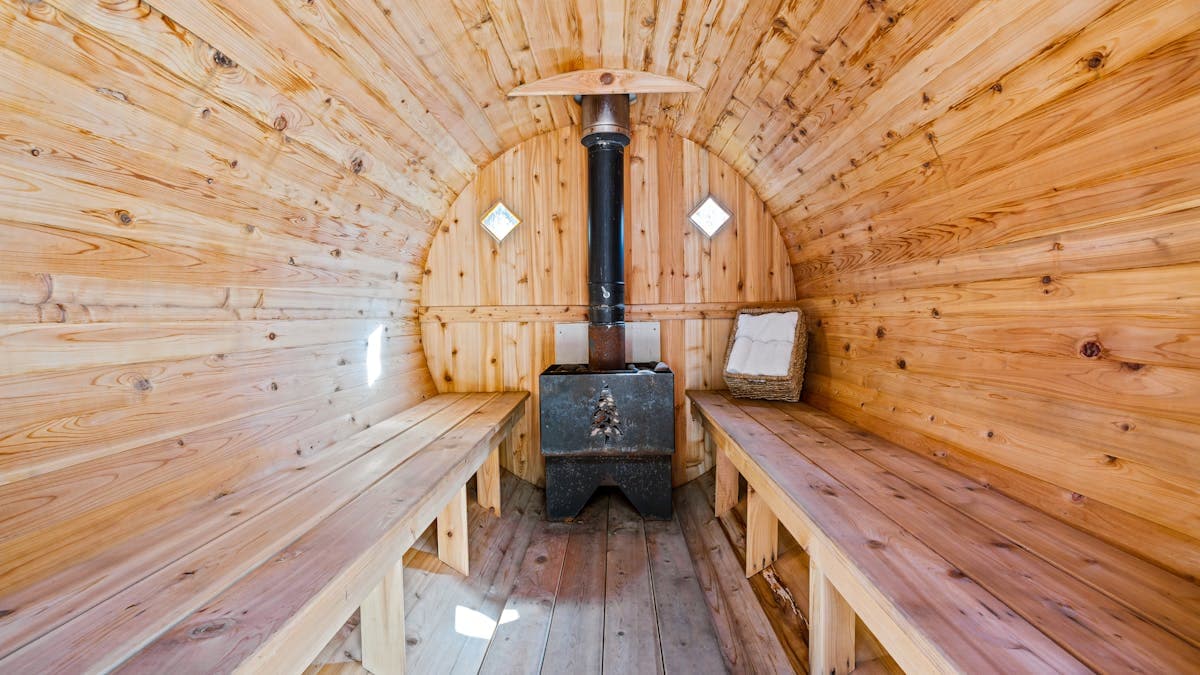
- Outdoors means traditional hot-rock steam heat, a wood cabin or barrel, and higher temperatures with the option of pouring water on the stones.
- Indoors almost always means infrared: lower air temperature, radiant panels, no water, no venting, no foundation.
If you already know you want the steam and the ladle, you are shopping outdoor saunas. If you want the dry radiant heat at a lower temperature, you are shopping infrared saunas. Hybrids exist if you genuinely want both, and 11 of our outdoor models are hybrids.
What Each Side Actually Costs
These are the real list prices across our catalog, not estimates.
| Indoor infrared | Outdoor | |
|---|---|---|
| Models we carry | 88 | 38 |
| Starting price | $1,399 | $4,999 |
| Top of range | $9,999 | $18,999 |
| Heat type | Infrared panels | Traditional steam or hybrid |
| Shapes | Cabins and corner units | 14 barrels, 24 cabins and cubes |
| Delivery | Free curbside | Free curbside |
Two things people miss when they compare these columns. First, the outdoor floor is set by construction, not by luxury: a barrel or cabin is a weather-exposed structure with a stove, so there is no $1,500 version of it. Second, the cheapest thing on either list is not the cheapest thing to own, because the electrical work is not in the price.
Financing is available at checkout at 0% APR, subject to approval, on both sides.
Power and Install: The Part That Surprises People
This is where an outdoor sauna quietly adds cost, and where an indoor infrared cabin quietly saves it. Two real examples from our own spec sheets:
- The Dynamic Barcelona ($1,899, indoor infrared) lists 120V / 15A, a standard household outlet.
- The Golden Designs St. Moritz ($4,999, 2-person Pacific Cedar barrel) runs a 4.5kW Harvia electric heater and lists a 240V dedicated circuit.
That is the pattern across the catalog rather than a quirk of those two models. Most indoor infrared cabins run on a standard or dedicated 120V circuit. Outdoor traditional saunas need a 240V dedicated circuit run to the unit by a licensed electrician, and larger stoves list higher amperage still. Some models also call for a dedicated non-GFCI receptacle.
Check the spec table on the product page before you buy. Every model we list publishes its own electrical requirement, and they are not all the same even within one placement. If a 240V run to the back of your yard is expensive at your house, that cost belongs in the comparison alongside the sticker price.
Outdoor units also need a level, load-bearing base. A concrete pad, pavers, a deck rated for the weight, or a gravel base are all normal. Indoor infrared cabins sit on an existing finished floor and need clearance around the panels, nothing more.
Which One Fits You?
Go indoor if: you want to be using it this month, you would rather not hire an electrician, your budget is under about $3,000, or you live somewhere with a real winter and you know you will skip a walk across a cold yard. Start with the full infrared lineup, filtered by how many people will actually use it.
Go outdoor if: the traditional steam experience is the point, you have the outdoor space and a way to power it, and you want the sauna to be a destination rather than a piece of furniture. Start with the outdoor lineup, which is organised by shape: barrels from $4,999 and cabins and cubes from $5,990.
A note on the middle ground. A garage is the most common answer we hear, and it usually behaves like an indoor install: existing floor, existing outlet, no weather exposure. If your garage is unconditioned and gets very cold, an infrared cabin will still work, it will simply take longer to come up to temperature.
If you have the space measured and still cannot call it, answer four questions in our Find My Sauna tool and it will match you to real models at real prices, or text a specialist at (623) 300-0464 with your dimensions and how many people will use it.
Frequently Asked Questions
Can you put an infrared sauna outside?
We do not list one, and that is deliberate. All 38 outdoor saunas we carry are traditional steam or hybrid models, because an outdoor unit has to be a weather-rated structure. Infrared cabins in our catalog are built for indoor installation on a finished floor. If you want infrared and you only have outdoor space, the realistic options are an enclosed porch, a garage, or an outdoor hybrid model that includes infrared alongside a traditional stove.
Is an outdoor sauna more expensive than an indoor one?
Yes, on both the sticker and the install. Our outdoor saunas start at $4,999 and run to $18,999, while indoor infrared cabins start at $1,399 and run to $9,999. Outdoor units also typically need a 240V dedicated circuit run by an electrician plus a level base such as a concrete pad or rated deck, none of which is included in the price. Indoor infrared models commonly run on a standard 120V household outlet.
Does an indoor sauna need special wiring?
Often not. Many indoor infrared cabins, including the Dynamic Barcelona at $1,899, list 120V / 15A on a standard household outlet. Some larger indoor models call for a dedicated 120V / 20A circuit, and a small number require 240V. Check the electrical line in the spec table on each product page before you buy, because the requirement varies by model rather than by category.
Do outdoor saunas hold up in winter?
They are built for it. Our outdoor barrels and cabins use exterior-grade wood construction such as Pacific Cedar and are designed for year-round outdoor installation. The practical winter question is not durability, it is whether you will actually walk out to it. That is a genuine reason some buyers choose an indoor cabin even when they have the yard for an outdoor one.
What is the difference between a barrel sauna and a cabin sauna?
Shape and interior feel. We carry 14 outdoor barrels and 24 outdoor cabins and cubes. A barrel's curved wall puts the ceiling closer to the bathers, which heats faster and concentrates the steam, and barrels start lower at $4,999. Cabins and cubes give you straight walls, more headroom and usually more usable bench layout, starting at $5,990.
Which is better for someone new to saunas?
Indoor infrared, in most cases. It is the lower price of entry, it usually plugs into an existing outlet, and the lower air temperature is easier to sit in for a first session. Buyers who already know they love traditional steam heat, usually from a gym or a club, are the ones who tend to go straight to an outdoor barrel.
Tags
Need help choosing?
Tell us your space, budget, and goal, we'll send 2-3 real picks with accurate freight and transparent pricing. One reply from a US-based specialist within a few business hours. No spam.