The Short Answer
Sauna heaters are sized by the volume of the sauna room, not by how many people sit in it. Measure length x width x height, then pick the heater whose published volume range covers that number.
Every heater manufacturer publishes a sizing table, and it is the table that matters, not a rule of thumb. Harvia and HUUM both publish minimum and maximum volumes for each model. The minimum is not a suggestion: an oversized heater in a small room cycles off before the room and the stones are properly heated.
Two things surprise most first-time buyers:
- Uninsulated surfaces change the math. Glass, tile, brick, and log walls absorb heat, so your calculated volume is larger than your measured volume. Both brands publish an adjustment, and they are not the same adjustment.
- Sizing is a warranty condition, not advice. HUUM states it outright: the manufacturer's warranty is not valid if heater output does not match the calculated room volume.
This guide uses only the ranges Harvia and HUUM publish for the exact models we stock. We are an authorized Bathing Brands dealer for both.
Step 1: Measure Your Room Volume
Multiply the interior dimensions of the sauna room: length x width x ceiling height. Use interior finished dimensions, not the framing.
A typical 6 ft x 5 ft room with a 7 ft ceiling is 210 cubic feet, or about 5.9 cubic meters. Manufacturer tables are published in cubic meters (Harvia's US manuals print both units), so it is worth knowing both numbers. To convert, divide cubic feet by 35.31.
Ceiling height matters more than people expect, because it multiplies. Dropping a 8 ft ceiling to 7 ft in that same room takes you from 240 to 210 cubic feet and can move you down a heater size. Traditional saunas are also generally happier with lower ceilings: heat stratifies, and a tall room spends energy heating air above your head.
Step 2: Adjust for Glass, Stone, and Log Walls
This is the step most sizing mistakes come from. If your room has surfaces that store or leak heat, your calculated volume is bigger than the tape measure says, and the two brands handle it differently. Use the rule that belongs to the heater you are buying.
HUUM uses an additive rule. From the HIVE and CLIFF installation manuals, word for word:
"In case there are any uninsulated brick, tile, glass or log walls in the sauna room, an additional calculated volume of 1 m³ should be added to the sauna room for each such square meter of the wall."
So a HUUM-heated room with 3 square meters of glass door and window is sized as if it were 3 cubic meters larger than it measures.
Harvia uses a multiplier, and only for log walls. From the Virta owner's manual:
"Because log walls are heated slowly, the cubic volume of a log sauna should be multiplied by 1.5, and the heater output should then be selected on the basis of this information."
Harvia's published tables assume a well-insulated room with wood-panelled walls and ceiling. Harvia notes separately that power requirements increase with window surfaces or heat-storing surfaces such as brick, concrete, or massive logs, but does not publish a specific number for glass the way HUUM does. If your Harvia room has significant glass, that is a conversation worth having before you order rather than a calculation to guess at.
Do not blend the two rules. They are different manufacturers describing different heaters.
Step 3a: Harvia Sizing Table (Every Model We Carry)
These are Harvia's published figures from the Virta owner's manuals for the US market, which print cubic meters and cubic feet side by side. Prices are our regular prices.
| Model | Output | Room volume | Cubic feet | Price |
|---|---|---|---|---|
| Virta Combi (240V 1PH) | 8.0 kW | 5 to 12 m³ | 177 to 431 | $3,648 |
| Virta Combi (240V 1PH) | 9.0 kW | 5 to 14 m³ | 177 to 494 | $3,711 |
| Virta Combi (240V 1PH) | 10.5 kW | 5 to 18 m³ | 177 to 635 | $3,770 |
| Virta Combi (208V 3PH) | 10.5 kW | 5 to 18 m³ | 177 to 635 | $3,833 |
| Virta Pro (240V 1PH) | 16 kW | 10 to 26 m³ | 354 to 918 | $3,736 |
| Virta Pro (208V 3PH) | 20 kW | 10 to 32 m³ | 354 to 1,130 | $4,943 |
The Combi line carries an integrated steam generator, so one unit gives you dry heat and humidity. The Pro line trades that for raw output and scales to very large or light-commercial rooms. Every Harvia heater we carry is made in Muurame, Finland, ships as LTL freight, and carries a 5-year manufacturer warranty.
Note the 10 m³ floor on the Pro line. A 16 kW Pro is not a "better" heater for a 6 m³ home sauna, it is the wrong heater for it.
Step 3b: HUUM Sizing Table (Every Model We Carry)
These are HUUM's published figures from Table 1 of the HIVE and CLIFF installation manuals. HUUM publishes cubic meters only, so the cubic-foot column below is our own conversion at 35.31 cu ft per m³, not a HUUM figure. Prices are our regular prices.
| Model | Output | Room volume (HUUM) | Cubic feet (converted) | Price |
|---|---|---|---|---|
| HUUM CLIFF | 9.0 kW | 8 to 13 m³ | 283 to 459 | $2,638 |
| HUUM CLIFF | 10.5 kW | 10 to 16 m³ | 353 to 565 | $2,879 |
| HUUM HIVE Mini | 9.0 kW | 8 to 13 m³ | 283 to 459 | $2,657 |
| HUUM HIVE Mini | 10.5 kW | 10 to 16 m³ | 353 to 565 | $2,785 |
| HUUM HIVE | 12.0 kW | 12 to 18 m³ | 424 to 636 | $2,848 |
| HUUM HIVE | 15.0 kW | 15 to 23 m³ | 530 to 812 | $3,088 |
Two naming notes that trip people up when cross-shopping. HUUM's model names round up, so the 10.5 kW units are branded "CLIFF 11" and "HIVE Mini 11" even though the spec table lists them at 10.5 kW. And the full-size HIVE line starts at 12 kW: if you want 9 kW in the HIVE family, that is the HIVE Mini, which is a different chassis with a smaller stone capacity, not simply a smaller HIVE.
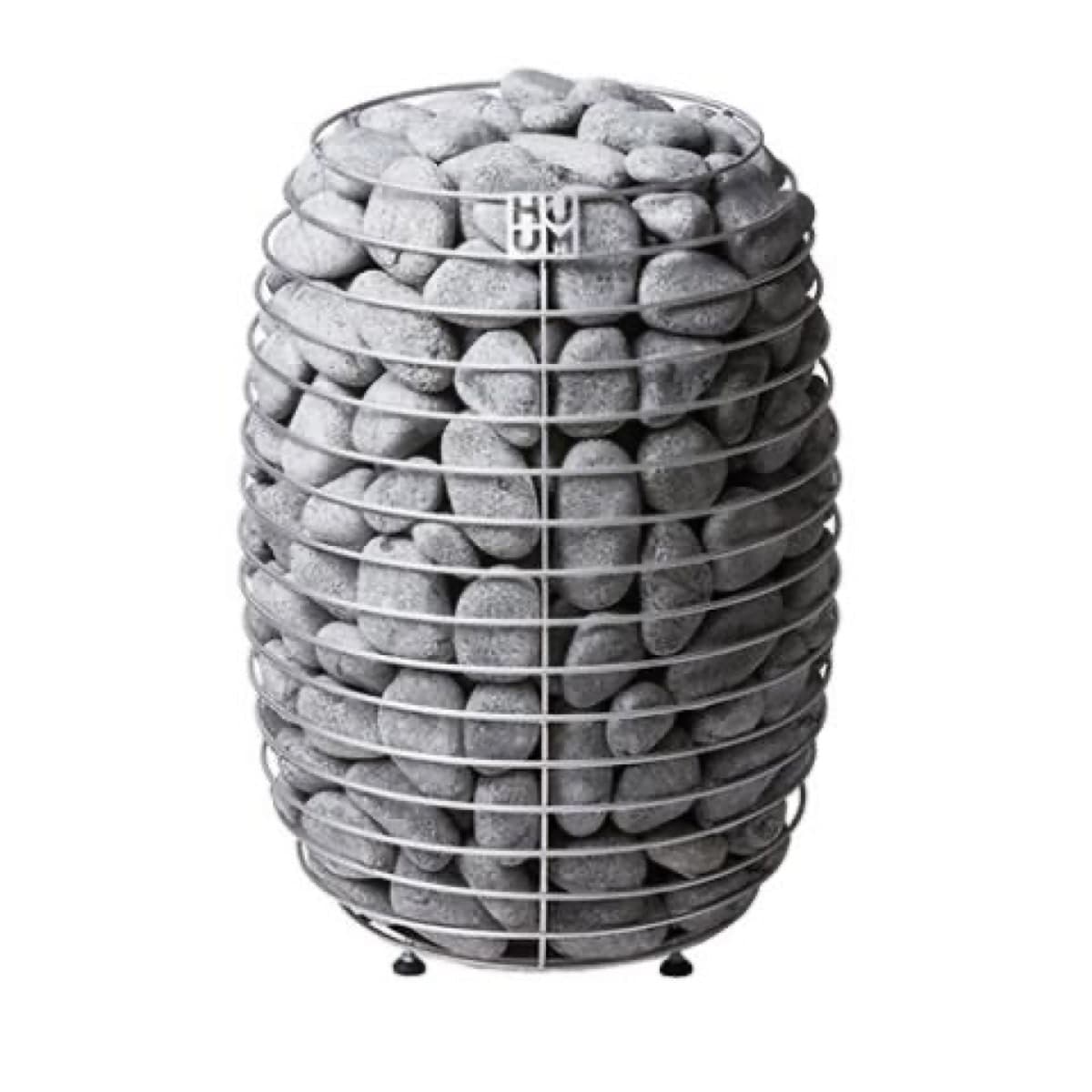
The HIVE and Mini differ in stone mass, and stone mass is what carries you through a löyly. More stones means a softer, longer steam burst and a more forgiving room. That is the real reason to move up the HUUM range, more than raw kW.
A Worked Example
Say you are finishing a 6 ft x 6 ft room with a 7 ft ceiling, with a standard glass door.
- Measure: 6 x 6 x 7 = 252 cubic feet, or 252 / 35.31 = 7.1 m³.
- Adjust: a typical glass sauna door is roughly 1.6 m³ of surface. Under HUUM's additive rule that is about +1.6 m³, taking you to roughly 8.7 m³ calculated. Under Harvia's rules, a panelled, well-insulated room with no log walls uses the measured 7.1 m³ and treats the glass as a reason to lean up rather than a fixed number.
- Select: at ~8.7 m³ calculated, the HUUM CLIFF 9.0 kW (8 to 13 m³) fits cleanly. On the Harvia side at ~7.1 m³, the Virta Combi 8.0 kW (5 to 12 m³) covers it, and the 9.0 kW (5 to 14 m³) gives you headroom if the room runs cold or the glass is larger than typical.
Notice that the same room lands on different sizes depending on whose rule you follow. That is not a contradiction, it is two manufacturers modelling heat loss differently. Follow the rule that belongs to the heater you are actually buying.
Before You Order: Electrical Reality Check
Every heater on this page is a hard-wired 240V or 208V appliance that needs a dedicated circuit installed by a licensed electrician. This is the single biggest difference between a traditional sauna and a plug-in infrared cabin.
If you want a sauna that runs on the outlet already in the room, you want infrared, not a rock heater. Our Dynamic Barcelona at $1,899 and Cardoba Elite at $2,299 both run on a standard 120V/15A household outlet with no electrician. See what outlet a home sauna really uses for the full breakdown, and infrared vs traditional if you are still deciding between the two experiences.
Sizing the heater is only half the job. Confirm your electrical service, the circuit rating each model requires, and your control system before ordering, because a heater that arrives for a circuit you do not have is an expensive freight return.
Have Us Check Your Numbers
Heater sizing is the one decision in a traditional sauna build that is genuinely unforgiving: it sets your warranty validity, your heat-up time, and whether the room ever feels right. It is also the one where a five-minute conversation beats an afternoon of forum reading.
Send us your interior dimensions, ceiling height, and roughly how much glass or stone is in the room, and we will tell you which models your room actually falls into and which we would pick. We are an authorized dealer for both Harvia and HUUM, so we have no reason to push you up a size.
Text or call our US-based buying advisors at (623) 300-0464, or request a free quote with your dimensions. If you are still choosing a brand, our HUUM vs Harvia comparison covers what each one optimizes for, and you can see every sauna heater and stove we stock with published kW ratings and current pricing.
Frequently Asked Questions
What size sauna heater do I need?
Size by room volume, not by seat count. Multiply interior length x width x ceiling height, add volume for any uninsulated glass, tile, brick, or log surfaces, then pick the heater whose published range covers that number. As a reference point, a 6 ft x 6 ft room with a 7 ft ceiling is about 7.1 cubic meters, which lands on a Harvia Virta Combi 8.0 kW (5 to 12 m³) or a HUUM CLIFF 9.0 kW (8 to 13 m³) once glass is accounted for.
Is there a kW per cubic meter rule for sauna heaters?
Neither Harvia nor HUUM publishes one, and we will not invent one. Both manufacturers route buyers to their sizing tables instead, because minimum volumes, stone mass, and wall construction all shift the answer. Use the table for the specific model you are buying.
Can a sauna heater be too big for the room?
Yes, and this is the mistake people make when they assume more power is safer. Every published range has a minimum as well as a maximum. An oversized heater satisfies the thermostat and cycles off before the stones and the room are properly heated, which gives you a hot-feeling room that cannot produce a decent löyly. HUUM also states that the manufacturer's warranty is not valid if heater output does not correspond to the calculated volume of the sauna room.
Do glass walls change what heater I need?
Yes. Glass is an uninsulated surface that pulls heat out of the room. HUUM publishes an additive rule: add 1 cubic meter of calculated volume for every square meter of uninsulated brick, tile, glass, or log wall. Harvia's tables assume a well-insulated, wood-panelled room, applies a 1.5x multiplier for log saunas, and notes that window and heat-storing surfaces raise the power requirement without publishing a fixed figure for glass.
Do traditional sauna heaters need special wiring?
Yes. Every Harvia and HUUM heater we carry is hard-wired at 240V or 208V and requires a dedicated circuit installed by a licensed electrician. If you want a sauna with no electrician, choose an infrared cabin such as the Dynamic Barcelona at $1,899, which runs on a standard 120V/15A household outlet.
What is the difference between the HUUM HIVE and the HIVE Mini?
They are different chassis, not the same heater in two sizes. The full-size HIVE line starts at 12 kW and covers 12 to 18 m³ (12.0 kW) or 15 to 23 m³ (15.0 kW). The HIVE Mini covers smaller rooms at 8 to 13 m³ (9.0 kW) or 10 to 16 m³ (10.5 kW) and holds fewer stones. More stone mass gives a softer, longer steam burst, which is often the better reason to move up the range than kW alone.
Tags
Need help choosing?
Tell us your space, budget, and goal, we'll send 2-3 real picks with accurate freight and transparent pricing. One reply from a US-based specialist within a few business hours. No spam.