The Quick Answer
The wood is almost never the decision. It is the consequence of a decision you already made.
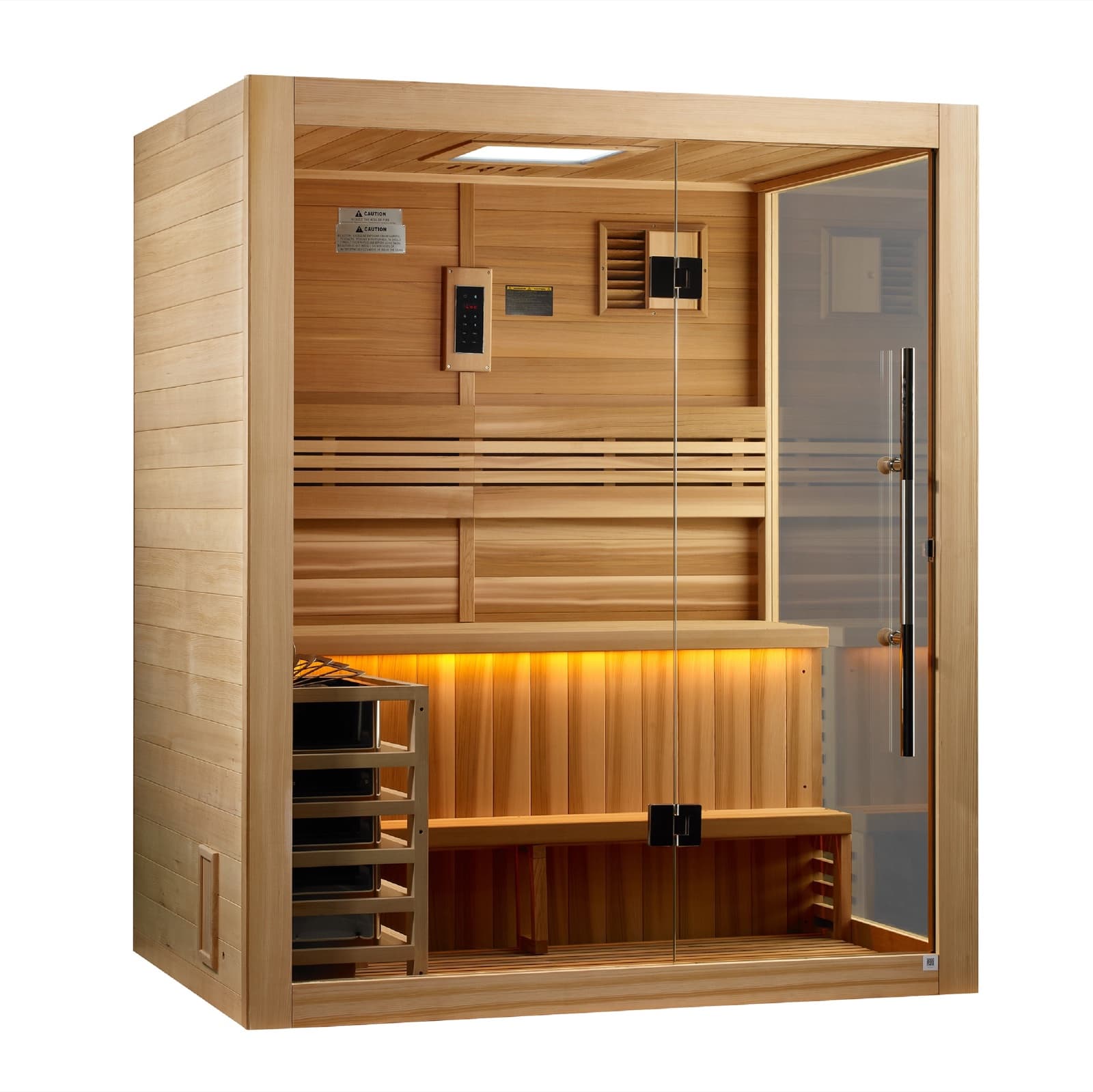
- Pick an indoor infrared cabin and you will most likely get Canadian Hemlock. 69 of our 88 indoor infrared saunas are hemlock and only 19 are cedar.
- Pick an outdoor sauna and you will most likely get cedar or thermally treated spruce. 29 of our 38 outdoor models are one or the other.
- Cedar is not a price tier. It appears in our smallest one person indoor cabinets and in our largest six person outdoor barn hybrids, which are the most expensive saunas we sell.
- The only aisle where two woods genuinely compete on the same shelf is indoor infrared, and even there hemlock outnumbers cedar more than three to one.
If you have not settled indoor versus outdoor yet, that question decides far more than the wood does, and our indoor vs outdoor sauna guide is the better place to start. If you already know it is going inside, keep reading and then browse the full range by size and price.
What 143 Saunas Are Actually Built From
We counted every sauna in our catalog and read the material spec each manufacturer publishes for it. Every single one names its wood, so none of this is inference.
- 87 saunas name Canadian Hemlock. 79 of them are indoor, and 69 of those are infrared cabins.
- 46 saunas name cedar, either Pacific Cedar or Canadian Red Cedar. 28 are indoor and 18 are outdoor.
- 13 saunas name Nordic or Thermo-Spruce. All 13 are outdoor traditional kits.
- 2 saunas name both hemlock and cedar, using one for the shell and the other for the interior.
Look at where each wood clusters rather than at the wood itself. Hemlock is 79 indoor against 8 outdoor. Spruce is 13 outdoor against zero indoor. Cedar is the only one that genuinely appears on both sides of the wall, 28 indoor and 18 outdoor. That is the shape of the whole decision.
Indoor Infrared Is the Only Aisle Where You Really Choose
Across our 88 indoor infrared saunas, 69 are hemlock and 19 are cedar. This is the one place where two cabins of similar size and similar heater technology sit next to each other in different woods, and the wood is genuinely part of what you are comparing.
What cedar buys you in this aisle is the aroma and the grain, not more sauna. Our manufacturers describe cedar as tight grained, naturally rot resistant, dimensionally stable across the temperature swings of daily use, and aromatic. They describe hemlock as naturally resistant to moisture, warping and odor, with good insulation and heat retention. Both descriptions are about surviving a hot, humid box every day. Only one of them promises a smell.
So the honest test is whether you want the cedar scent in the room. If you do, it is a real and lasting difference and worth paying for. If you are indifferent to it, the hemlock side of the aisle is four times deeper, which means more sizes, more heater configurations and more chances to find the exact footprint your room will take. Whether to spend the difference on full spectrum heaters instead is covered in our full spectrum vs far infrared comparison.
Outdoors, Hemlock Is the Exception
Of our 38 outdoor saunas, 18 are cedar, 13 are thermally treated spruce, and only 8 are hemlock. Here the wood claim is doing real engineering work rather than marketing, because the material has to survive weather.
Cedar's natural rot resistance is why it ends up on barrels and staves that sit in rain and snow. The Golden Designs St. Moritz 2-Person Barrel Traditional Steam Sauna at $4,999 is the least expensive outdoor sauna we sell, and it is a Pacific Cedar barrel.
Thermo-Spruce is the other answer, and it is a different strategy. It is spruce that has been heat treated so the wood itself becomes more stable and rot resistant, rather than relying on a coating or an oil. The spec sheet on our SaunaLife Model G11 Outdoor Home Sauna Kit at $16,980 lists that Thermowood treatment as delivering roughly twice the lifespan of cedar. Every spruce sauna we list is outdoor, and none of them is an entry level product.
The 8 outdoor hemlock models are purpose built outdoor units from Golden Designs with weatherized exteriors and roofing, starting with the Arlberg 3-Person Traditional Outdoor Steam Sauna at $5,999. That is a very different thing from taking an indoor hemlock cabin outside, which is not rated for weather exposure and voids the manufacturer warranty on every indoor model we carry. The wider reason outdoor saunas start where they do is covered in why there is no cheap outdoor sauna.
What the Wood Actually Changes, and What It Does Not
It is worth being precise about this, because a lot of sauna copy implies the wood changes the therapy. It does not.
The wood does change: the smell of the room, the color and grain you look at every day, how the shell handles moisture over years, and outdoors, whether the structure survives weather without an ongoing coating regime.
The wood does not change: how hot the sauna gets, how fast it heats, what it costs to run, or the wavelength your heaters emit. Those are set by the heater and the cabin volume. If you want to know what a session actually costs, we did the arithmetic in how much an infrared sauna costs to run.
The practical version: choose indoor or outdoor, choose your capacity, choose infrared or traditional. By the time you have made those three calls the wood has usually chosen itself, and the only live question left is whether cedar's aroma is worth the difference on the two or three models still in front of you.
Frequently Asked Questions
Is cedar better than hemlock for a sauna?
Not in a way that changes how the sauna performs. Cedar is aromatic, tight grained and naturally rot resistant, which is why it dominates outdoor builds. Hemlock is described by our manufacturers as naturally resistant to moisture, warping and odor, with good heat retention. For an indoor cabin either wood does the job, and the difference you will actually notice day to day is the smell.
Which wood do most home saunas use?
Canadian Hemlock, by a wide margin, at least indoors. 87 of the 143 saunas we list name hemlock and 79 of those are indoor units. Cedar accounts for 46 and skews outdoors, and thermally treated spruce accounts for 13, all of them outdoor kits.
Can I put an indoor hemlock sauna outside?
No. Indoor cabins are not rated for weather exposure and putting one outdoors voids the manufacturer warranty on every indoor model we carry. We do list 8 outdoor rated hemlock saunas, built for it with weatherized exteriors and roofing, starting at $5,999.
What is Thermo-Spruce and is it better than cedar?
Thermo-Spruce is spruce that has been heat treated so the wood itself becomes more stable and rot resistant, rather than relying on a coating. The spec sheet on our SaunaLife G11 kit lists the Thermowood treatment as roughly twice the lifespan of cedar. All 13 spruce saunas we list are outdoor traditional kits, so it is a premium outdoor option rather than a cheaper alternative.
Does the wood affect how much a sauna costs to run?
No. Running cost is set by heater wattage and how long you run it, not by the species of wood in the walls. Insulation quality and cabin volume matter more than the wood name on the spec sheet.
Tags
Need help choosing?
Tell us your space, budget, and goal, we'll send 2-3 real picks with accurate freight and transparent pricing. One reply from a US-based specialist within a few business hours. No spam.